Well, it’s 2012 and I’ve made some resolutions. I like to make a lot of them every year, because statistically I can probably manage to stick to one or two just by virtue of having about fifty. Some of them are pretty easy, like “Don’t drink drain cleaner,” and “try and avoid contracting a heritable disorder,” but some of them, like “Don’t use hand sanitizer to get drunk in prison” are tougher. Some things are just beyond my control.
One thing that I have actually committed to doing is to write more about issues that matter to me. It’s super easy for me to craft a post for the sole purpose of referring to Daniel Quinn as a total asshole, but not so easy for me to deliberately confront my own defensible truths. And so in my first post this year, I want to write about something that I think is really important to a lot of people, and that’s a frank discussion of the doctrine of fear surrounding vaccinations.
I have been flippantly censorious of the vaccine phobia more than once on this blog, and I unequivocally stand by my position that exposure to Jenny McCarthy should result in a quarantine. I will, admit, however, that statements like that don’t really serve to educate or conciliate people who don’t already agree with me, and I’m not sure that it’s not an irresponsible application of my education in health sciences to alienate people who have legitimate curiosities about the dangers of vaccines.
Historically, the implementation of all public health interventions has been characterized by a conflict between personal autonomy and public benefit. This poses a formidable dilemma. The ethical execution of public health should always take into account the fact that implementing public health programs creates a palpable tension between individual autonomy and perceived population benefit. While it is, of course, requisite that there always be an explicit respect for persons inherent in every public health action, there are instances in which the overarching principle of beneficence takes precedent. Those instances must be carefully analyzed and objectively evaluated, and they are rare and far between. Newborn screening programs, childhood vaccinations and water fluoridation are three of relatively few such programs ever implemented in the United States. The conflict is not one that policy makers underrate; it’s difficult to minimize the impact of what might be characterized as a transgression on personal freedoms in a society as committed to individual liberty as ours.
This is especially difficult when policy dictates that we impose a measure in the name of public health that is perceived as dangerous, and potentially harmful. Vaccinating children is such a measure, and the controversy generated by state laws mandating these vaccinations has been prodigious.
It is really easy for those of us in public health to dismiss dissenters as lunatics and morons. It is really, really easy to wax lyrical about the fatuity of this movement, to make fun of the maniacs who commit violations of federal laws to expose their children to infected candy mailed to them by a stranger from the internet, OH MY GOD.
But it is ultimately not very helpful.
It is irresponsible and harmful to dismiss this population as imbecilic or insane. I realize that it’s simpler, and I’ve been guilty of it myself, but in many ways that behavior reduces you to the practice of blaming the victim. The central tenet of public health is not that we show respect only for the people who agree with us. Public health requires a necessary element of education, because you are not dealing with a horde of scientific practitioners, you are dealing with the public. IT SAYS SO RIGHT IN THE FUCKING NAME. Public health. And public opinion matters, especially in a case like this.
So in my opinion, it is far more efficacious to acknowledge that these fears exist, and that the potential impact of these fears on the overall health of our population is significant. And that, whether or not we believe wholeheartedly that these fears are ignorant, or wrongheaded, or pernicious, we do not fulfill our duty to one another by deriding those beliefs. So here are some facts.
Vaccines work by providing the body with an ersatz version of the disease in question, and allowing the body an opportunity to mount a response to the fascimile, without exposing the individual to the whole package. Diseases are neutralized for vaccines in different ways. Often, the infectious agent is killed by heat or other chemicals. sometimes, the virus' ability to reproduce is destroyed, meaning that the disease cannot mulitply in the body. For some diseases, like hepatitus, it is enough to simply expose the immune system to an associated protein. Once a virus has been killed or neutralized, it cannot hurt you. The illness that people feel after receiving a vaccine is not the virus contained in the vaccine, it is your immune system responding to a foreign agent, memorizing it, and mounting a response designed to remove it. Once your immune system has recognized something as harmful, it can be destroyed. And given another exposure, your body will simply annihilate the intruder without the necessity of a full scale immune response. This is why people only get the chicken pox once - your body won't be fooled twice by the same trick. Colds and influenzas are slightly different, since those viruses are always changing and adapting. This is why some people get a flu shot every year.
The truth is that vaccines are not always 100% safe. They contain some preservatives that look and sound alarming. They occasionally precipitate an immune system response that can be unpleasant. Other safety concerns have revolved around mercury and Thimerosal, which is a compound containing organomercury, historically used as a preservative in vaccines and other medications. Over the course of the last decade, safety concerns about the use of Thimerosal (also known as Merthioloate, the trade name of the compound developed by Eli Lilly) have prompted the FDA to phase out its use from vaccines given to children under six. That means that the Measles, Mumps and Rubella vaccine, traditionally given at 18 months, does NOT contain Thimerosal.
It is worth noting that all of the multiple trails testing the safety and efficacy of Thimerosal have suggested that the compound is safe for the controlled uses to which it is put. However, public opinion and preference has guided the evolution of policy on this issue; and the development of more acceptable compounds has made the substitution much easier.
One exceedingly harmful myth about vaccines is that the government requires them simply because the government is in business with big pharma. THAT IS FALSE.
Vaccines themselves reside in a nebulous legal category known as "Unavoidably Unsafe." This is a designation given to drugs that are deemed necessary for population health, but which cannot be designed to be entirely innocuous. This label means that there is a certain amount of risk inherent in the treatment, but that the benefits outweigh the harms so significantly that there can be no question about the propriety of administering it.
If a company were to be held responsible for every adverse side effect resulting from a drug, there would be an enormous economic disincentive to making that drug. This is why safety trials are necessary. If, however, the product is considered necessary, the companies that create these products are allowed a certain amount of indemnity from litigation, in order to assure that access to these necessary treatments is retained.
Products must meet very, very specific criteria in order to be considered "Unavoidably Unsafe." The product must be produced to the standard specifications, meaning that there must be no error or negligence in the actual production of the product that caused the damage. If a company were to make a mistake in a batch of vaccines, for instance, and accidentally add a bunch of rat poison, the product would not be considered "Unavoidably Unsafe," it would be considered "Shitty." Secondly, the marketers of the product must be transparent about the potential known risks. The product must, as discussed above, have a clinical utility that greatly overrides the potential for harm, and there must be no other alternative to the product available.
As it stands, we don't have a better alternative for vaccines. They can sometimes cause our immune systems distress. Care providers are honest about those potentials, and vaccines have proven to be so advantageous and beneficial that those risks have been deemed acceptable. And all of this would be ok, if it weren't for our 21st century witch hunt for the causes of Autism.
An additional truth is that the vaccine schedule is, in fact, kind of arbitrary. Vaccines are scheduled at 18 months because they will conform to the changes in a child's immune system as they acquire their own resistance, and so they will coincide with established wellness checkups. That is convenient, and in the consumer driven medical market that we have created for health care, convenience is king. It is also true that 18 months is the time that many symptoms of disorders on the autism spectrum become apparent. It’s understandable that this connection might be where we start to look for a causal relationship.
What it is imperative to remember is that correlation is not causation. A 1998 study published in the British Medical Journal, The Lancet, claimed to have demonstrated a causal link between vaccinations and the onset of traditional symptomology pathognomonic of autism. This study terrified people, and caused a widespread panic. Consequentially, many people refused to vaccinate their children, and the findings were widely publicized by the media. Over the subsequent decade, follow-up studies failed to replicate the results, all of the co-investigators of the study dissociated themselves from the paper, and in 2010, the Lancet itself withdrew the publication. What this means is that the information and the associations supported by the data collected in the study have proven to be spurious. As it turned out, the lead investigator was found to have fabricated those data, and was forced to acknowledge the fraud in ignominy. The twist here is that this retraction was not as widely publicized as were the initial study findings. The NIH and the WHO did not embark on an aggressive media campaign, trusting that every mom in the world had nothing better to do than refresh the lancet website daily researching ethics violations. Even I only do that when I’ve been drinking cooking wine and thinking bitter thoughts about Anthony Bourdain.
So what we’re left with is a significant proportion of the population that have been grievously misinformed by a primary source, which was subsequently interpreted and disseminated by innumerable other sources and inadequately refuted by organizations that should have made it a top priority. By then it was a little late; the damage was widespread, and the consequences are becoming apparent.
The concept of population health is in a way self-sustaining, in that we rely heavily on acquired or achieved immunity in others to protect ourselves. We call this “herd immunity,” and we base our assumption on the principle that diseases rely on susceptibility in their target organisms to spread. reducing the overall susceptibility in a population provides less opportunities for infection, thereby reducing the rate of incidence. When a large cadre of people fail to acquire immunity through vaccination, an infected agent’s ability to spread is greatly increased. Already in the United States we are seeing the consequences of the reluctance to vaccinate, in resurgences of diseases we had previously suppressed, such as whooping cough, and Rubella.
the vast majority of opposition to vaccinations is predicated on information that was fraudulently derived, and irresponsibly disseminated. I think that frustration with this misinformation is driving a large proportion of the intolerance that many medical professionals are demonstrating when people express their concerns, but I don't feel that that frustration gets us anywhere.
Our society places a high value on the principle of autonomy. And if you are an advocate of autonomy, it's important to realize that the option of choice should be exercised responsibly, and on the basis of the best information available. Fear and tenuous supposition are poor substitutes for ratiocination and primary source material.
So let's be excellent to one another. And don't eat shit you bought on ebay. Jesus Christ, guys.
Thursday, January 19, 2012


Wednesday, April 27, 2011
A Mystery of the Orient: The Curious Case of the Caliginous Cabbie
Inner Mongolia is barren as hell. Spindly cows stagger across the dehydrated plains. Mesas loom grimly above a parched landscape, acarpous and scorched. Rugged mosquitoes with slouchy porkpies and rank cigars roughly assault your sunburned skin. Water costs more than beer.

We trekked across the flatlands to join an academic conference in Xilinhot attended by several of Fred's classmates. Xilinhot is famous for giving a shit about Genghis Khan, by which I mean that Xilinhot is pretty much the cultural equivalent of the bar attached to a Super 8 motel somewhere in North Dakota on a Tuesday night. They have a cultural history museum, the top floor of which is dedicated to paper mache reproductions of the Tyrannosaurus Rex. They have a national gynecology hospital, flamboyant, evocative and nauseating in festive pinks and purples. What they do not have is a hotel willing to board foreigners or a restaurant that doesn't evoke the subconscious self loathing of a first date at a bowling alley.
Fred and I dragged our bags in and out of several reeking taxis, trudging from hotel to hotel. One woman screamed when she saw us. Another one called the police.

This turned out to be awesome, since the police decided it was part of their civic duty to find us a hotel. They placed us in the back of their police car and drove us down the seediest, most pathetic street that ever wended its useless way to a hole that would rent a room to white people.
 civil servants.
The hotel was hidden behind a high facade, festooned with topless men lounging gracelessly on the grimy bricks, T shirts tied around their slick foreheads, beer bottles sweating rivulets in the merciless heat. Women dangled ugly babies and stared vacantly as the police cruiser scraped its way up the uneven drive. At night, a motley and swashbuckling pride of indolent taxi drivers lurked around the hood of an idling Buick, smoking harsh cigarettes and squinting into the broken street.
One of the benefits of finding yourself in an area with limited tourist appeal is that there are fewer aggressive individuals with insinuating smiles that are willing to take you to see something for a "cheap price." One of the drawbacks is that there are still plenty of people willing to take you to see nothing for a whole lot.
So when a jovial, portly, middle aged cab driver offered to give us a tour of the terrain surrounding the city, including the places his parents took him as a child, we were mildly skeptical. "We don't get many foreign visitors here!" He exclaimed, rubbing his shiny forehead with an honest to god handkerchief. "I think it is our duty as citizens to show our visitors our country." Fred was for it because inner Mongolia is as boring as watching a cow starve. I agreed because my intuition is more likely to endorse an individual if he looks like Mr. Pickwick, regardless of ethnicity. D. agreed to come back for us after lunch, and told us he would charge us about 15 US dollars.
The first leg of the drive was beautiful, in a barren sort of way. D drove along the back roads so we could watch lanky, ochre colored boys drive spindly, wild horses across the plains.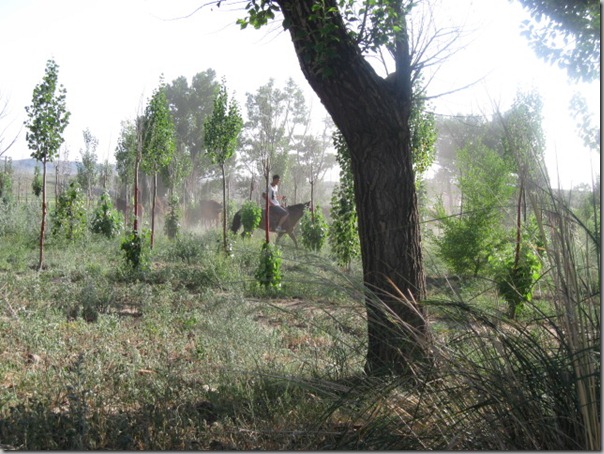
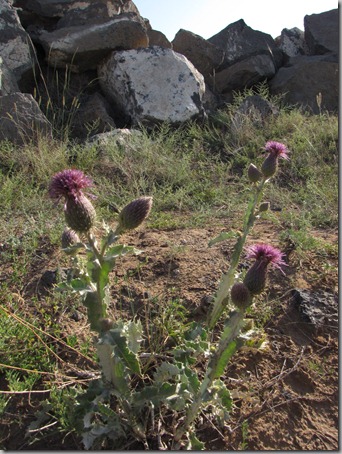
The parched ground was cracked, and nearly smoking in the noon sun. D. drove slowly, stopping every time I pointed my camera out the window. With the day at its hottest, we pulled the cab into an uneven gravel lot overlooking a wide swath of grassland. We ducked under the blistering arm of a wrought iron gate and hiked up the asphalt path until it ended. The plane was endless, and the rocky outcrops broke the smooth face irregularly, providing slivers of inadequate shade, jutting incongruously and impotently out of the landscape. Below us, blinding in the direct light of the summer sun, stretched the reservoir, the surface glassy and brilliant, crystalline and inviting.

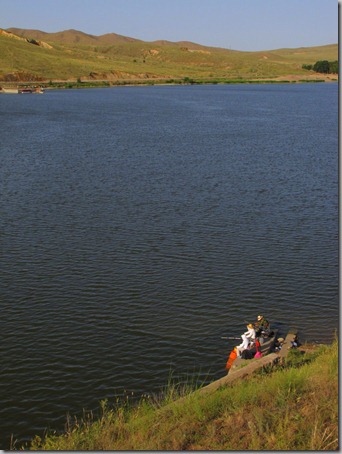
D. led us down a rocky path to the edge of the water, until the stones gave way to a thick, silky mud that coated our feet and left silicate grit between our toes. The water was extraordinary - cool and still, with silvery fish appearing and disappearing rapidly around our ankles. D. waded in up to his waist, and grinned at us. "I never learned to swim," he explained sheepishly. "This is the only water around."

Climbing back onto the rocky shore, we were greeted by a horde of obnoxious teenagers with cell phone cameras taking our picture. "Lao Wai!" They informed each other, pointing. "Lao Wai!" We affirmed. It was like first contact without the spaceship. I encourage you to go to China with a horde of other white people, and simply repeat everything that people say while they take your picture. If you really want to have some fun,
"dai4 wo3 qu4 kan4 ni3de ling2dao3"
means "Take me to your leader," and I suggest that you throw that in once or twice, just to up the ante a little. Trust me. It will be hilarious.
Tourism in China is essentially a carnival of shit that is ridiculously old, where you are hustled from one busted thing to the next and people attempt to sell you absurdly overpriced shirts that depict the busted thing you just saw. For years, tourists have gone to China and paid money to look at old busted shit, which is why, when you go to China, people are really enthusiastic about charging you money to see shit that is old and busted. China is really capitalizing on the two pronged theory that 1) things that are "Ancient and Beautiful" are attractive to populations who continually recycle styles from 20 years ago like there is ANY amount of time that might make stirrup pants acceptable again, and 2) that those same populations with the fashion memories of goldfish are by extension unable to distinguish between a pile of rubble from a defunct noodle stand and some palatial ruins from the Ming dynasty. And who can blame them. We are the assholes acting like jeggings are reasonable. Just be thankful that the T-shirt you bought says you saw the great wall, even if it was "Ping’s discount hovel of pajamas." You know in your heart that it doesn't matter to you.
a tribute to a nobler age.Acting on the principle that the central tenet of Chinese tourism is "have built it several thousand years ago and they will come," China designs much of their new construction to look like old construction. Our guide led us back to the car, now nearly molten in the heat of the late afternoon, and suggested that he drive us a little out of our way to see the main attraction in the area: a fifteen foot tall replica of Genghis khan's head, molded in plastic and finished to look like ancient stone work; set imposingly on a hill above the largest highway in Xilinhot.
We hesitated. We were in the middle of nowhere, with little money, in sandals and swimsuits, with no other viable mode of transport, no one to call, and no reasonable alternatives. We looked at each other. We shrugged. We agreed reluctantly, and got in the car. We pulled out of the gravel lot, and rejoined the long dark highway snaking across the grasslands. five or ten minutes passed before we again pulled off the highway. D. shut off the engine. "Just a moment," he said to us.
If you are now, like we were then, reading this post waiting for the moment that our seemingly philanthropic guide dropped his mask and stood revealed to us in his true colors, you need to read no further. It was at this juncture that this man's character was exposed in all of its nakedness, burning like a brand in the vast expanse of the dry plains. He left the driver's seat, and moved around to the truck of the car. As soon as he was out of the car, I turned to Fred. "What is going on?!" I asked. We had no idea. Was this the moment he would demand additional payment for his unsolicited tour? Were we going to have to battle it out along the side of a desolate highway in the middle of god knows where in inappropriate walking shoes and damp clothing? Did he realize how threatening the eternal, unbroken plains appeared in the context of our potential disagreement? Would he abandon us? Rob us? Sell us? Would the bland, calcified fields surrounding us soon house the drying HUSKS OF OUR DESICCATED CORPSES? WOULD I BE MUMMIFIED IN FRIGGING MONGOLIA OVER A FIFTEEN DOLLAR TRIP TO VIEW AN ENORMOUS PLASTIC REPRODUCTION OF GHENGIS KHAN'S FAKE HEAD?
We waited anxiously, listening to the thumps and rustles coming from behind us as D. rummaged through the trunk of the cab. For shovels? Shackles? Firearms? Worse?
The sun was getting lower as D. opened the door and clambered back into the driver's seat, clutching a large sack. His ruddy face was filmed with sweat, and creased into a habitual congenial grin. Under the circumstances, his good natured smile seemed sinister, lochetic, foreboding. Nodding briefly and apologetically to me, he turned to Fred and spoke rapidly in Chinese.
Beaming, he produced two large water bottles from the bag, slick with glistening condensation, kept cold in a cooler in the trunk. Fred translated. "He thought we might be hungry, and he saw on a television special once that white people like to eat bread, so he went to the store. He wasn't sure what kind of bread white people like, though, so he bought us a couple kinds. He said they were out of coca cola, and they only had pepsi, so he got us water. He hopes that's ok. He knows Americans really like coca cola."
Although in a sense anti-climactic, the soft yellow loaf filled with dates and jam was delicious, the water welcome to throats as parched as the steppe. Our guide drove faster through the growing twilight, explaining that if we could mount the next hill quickly, we could watch the sun set over the bright silver rivers leading into the reservoir.
At the summit, we pulled the cab off into the bushes and turned to watch the deepening crimson rays glance brilliantly from the surface of the winding tributaries, and transform the dales into pools of gold and shadow. In the last dying light, a collapsing cottage caught the final beams and blazed into an unexpected beauty, radiant in its liquefaction, in the syrupy golden of the thickening dusk. Never had some old busted shit seemed so compelling in its desuetude; the steppe looked so homogenous in the broad day, but the growing penumbra highlighted the hills and dips. The light on the uneven plain fell in viscous chunks, collecting in dales and running slowly down the hillsides.


Then we turned our steps towards the head of Genghis Khan.

As it turns out, the head is better positioned to view from a distance than it is placed for tenable approach. In our plastic sandals, we climbed over barbed wire fences and the ruins of old cattle pens. Nettles brushed our legs, huge crickets exploded from the brush up into our faces, whirring and clicking like mechanized irritants. Outlined in the dusk, the silhouette was a prepossessing figure from the road. Up close, it was clear even in the advancing night that the paint was flaking, the plastic scraped and worn.
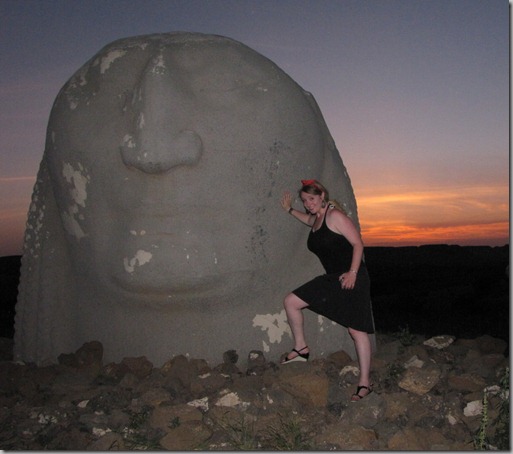
Bushwhacking our way back to the car in the dark, our guide remarked, “maybe we weren’t supposed to climb these fences.”
The freeway was dark, indistinguishable from the rest of our surroundings. No lamps lit the roadway, and there were few cars or trucks shining their headlamps through the summer night. We drove through the night in silence, occasionally irradiated by the headlamps of oncoming cars. Our guide’s face was thoughtful. The steppe was crossed with shadows in the moonlight.
When he broke the silence, his voice was hesitant, and quiet. Music was an important part of Mongolian culture and communication, he told us. Since we had asked so many questions about inner Mongolia, and about the people, he wondered if we would like to hear some traditional Mongolian songs?
We would.
His voice was surprisingly beautiful, pitched high and clear, with a deep expression and wide range. In the deepening night, with the dim luminance of the moon and the dashboard lights, the sound was mesmeric, soothing, compelling.
In the silence after the song, I felt the rising melancholy of homesickness, coupled with the strange sensation of being precisely where I belonged.
As we re-entered the city, D. received a phone call from his wife. He spoke with her for a few minutes, and then asked us if we had enough time to see some famous temples in the city. His wife had admonished him. “Who wants to see a hole filled with water? You should have taken them to the monastery!” As you may have divined, the temples had all been destroyed during the cultural revolution, but had been rebuilt to the exact specifications of a new thing that looks just as busted as it would look were it actually to have decayed over millennia.

His entire family was waiting there to welcome us.

D. looked anxiously over his glasses at us. His son, who had inherited the squat frame of his father, was uninterested in school. His grades were not good, and he insisted he wanted to be a famous basketball player. Maybe we could talk to him? If he were to meet some foreigners, perhaps he would become more interested in learning English?
His wife escorted us all over the temple. The night was clear and warm, and the public square was crowded with people. We posed for several pictures with the family, and talked with the son, and coaxed the daughter, who was terrified of us.

As it grew later, the family drove us home in the cab. They refused to accept any payment beyond the fifteen dollars we had paid earlier in the day, which would barely cover our host’s rent to the cab company, let alone the gas. “Maybe someday,” D. said wistfully, “If I can ever visit America, someone will show me their city, too.”
I thought,
Good luck, pal.
It beggars belief that out there in the world there are more than a scant handful of people who would, with a family to feed, abdicate an entire afternoon of income to spend eight hours showing two strangers the sentimental landmarks of their dreamy childhood; who would turn a stale, contrived burlesque of a temple into a warm, joyful family outing; who would volunteer the depth and breadth of their memories, experiences and tradition in the service of promoting education and understanding; who would modify their curiosity with a superhuman exertion of tact; who would, in light of a broken radio, sing the haunting lullabies of their babyhood in the weak light of an aging cab, a single speeding pool of light on a long, dark, unbroken road.
And please recall that he was out of pocket for several kinds of bread.
So if you ever come across this gentleman, out there in the world, marshal whatever forces you have at your disposal to conquer any baseness or selfishness or impatience in your nature. Set aside your daily concerns, defer some pressing obligations, and spend one afternoon treating a stranger to a personal guided tour of a place you grew up loving. Do it for me. Do it for Karma. Do it in the spirit of building international relations. Or just do it because nothing can approach the experience of encountering, in a howling wilderness, the lesson that ordinary people can have the extraordinary effect of becoming the kindest person you have ever met.


We trekked across the flatlands to join an academic conference in Xilinhot attended by several of Fred's classmates. Xilinhot is famous for giving a shit about Genghis Khan, by which I mean that Xilinhot is pretty much the cultural equivalent of the bar attached to a Super 8 motel somewhere in North Dakota on a Tuesday night. They have a cultural history museum, the top floor of which is dedicated to paper mache reproductions of the Tyrannosaurus Rex. They have a national gynecology hospital, flamboyant, evocative and nauseating in festive pinks and purples. What they do not have is a hotel willing to board foreigners or a restaurant that doesn't evoke the subconscious self loathing of a first date at a bowling alley.
Fred and I dragged our bags in and out of several reeking taxis, trudging from hotel to hotel. One woman screamed when she saw us. Another one called the police.

This turned out to be awesome, since the police decided it was part of their civic duty to find us a hotel. They placed us in the back of their police car and drove us down the seediest, most pathetic street that ever wended its useless way to a hole that would rent a room to white people.
 civil servants.
The hotel was hidden behind a high facade, festooned with topless men lounging gracelessly on the grimy bricks, T shirts tied around their slick foreheads, beer bottles sweating rivulets in the merciless heat. Women dangled ugly babies and stared vacantly as the police cruiser scraped its way up the uneven drive. At night, a motley and swashbuckling pride of indolent taxi drivers lurked around the hood of an idling Buick, smoking harsh cigarettes and squinting into the broken street.
One of the benefits of finding yourself in an area with limited tourist appeal is that there are fewer aggressive individuals with insinuating smiles that are willing to take you to see something for a "cheap price." One of the drawbacks is that there are still plenty of people willing to take you to see nothing for a whole lot.
So when a jovial, portly, middle aged cab driver offered to give us a tour of the terrain surrounding the city, including the places his parents took him as a child, we were mildly skeptical. "We don't get many foreign visitors here!" He exclaimed, rubbing his shiny forehead with an honest to god handkerchief. "I think it is our duty as citizens to show our visitors our country." Fred was for it because inner Mongolia is as boring as watching a cow starve. I agreed because my intuition is more likely to endorse an individual if he looks like Mr. Pickwick, regardless of ethnicity. D. agreed to come back for us after lunch, and told us he would charge us about 15 US dollars.
The first leg of the drive was beautiful, in a barren sort of way. D drove along the back roads so we could watch lanky, ochre colored boys drive spindly, wild horses across the plains.

The parched ground was cracked, and nearly smoking in the noon sun. D. drove slowly, stopping every time I pointed my camera out the window. With the day at its hottest, we pulled the cab into an uneven gravel lot overlooking a wide swath of grassland. We ducked under the blistering arm of a wrought iron gate and hiked up the asphalt path until it ended. The plane was endless, and the rocky outcrops broke the smooth face irregularly, providing slivers of inadequate shade, jutting incongruously and impotently out of the landscape. Below us, blinding in the direct light of the summer sun, stretched the reservoir, the surface glassy and brilliant, crystalline and inviting.


D. led us down a rocky path to the edge of the water, until the stones gave way to a thick, silky mud that coated our feet and left silicate grit between our toes. The water was extraordinary - cool and still, with silvery fish appearing and disappearing rapidly around our ankles. D. waded in up to his waist, and grinned at us. "I never learned to swim," he explained sheepishly. "This is the only water around."

Climbing back onto the rocky shore, we were greeted by a horde of obnoxious teenagers with cell phone cameras taking our picture. "Lao Wai!" They informed each other, pointing. "Lao Wai!" We affirmed. It was like first contact without the spaceship. I encourage you to go to China with a horde of other white people, and simply repeat everything that people say while they take your picture. If you really want to have some fun,
"dai4 wo3 qu4 kan4 ni3de ling2dao3"
means "Take me to your leader," and I suggest that you throw that in once or twice, just to up the ante a little. Trust me. It will be hilarious.
Tourism in China is essentially a carnival of shit that is ridiculously old, where you are hustled from one busted thing to the next and people attempt to sell you absurdly overpriced shirts that depict the busted thing you just saw. For years, tourists have gone to China and paid money to look at old busted shit, which is why, when you go to China, people are really enthusiastic about charging you money to see shit that is old and busted. China is really capitalizing on the two pronged theory that 1) things that are "Ancient and Beautiful" are attractive to populations who continually recycle styles from 20 years ago like there is ANY amount of time that might make stirrup pants acceptable again, and 2) that those same populations with the fashion memories of goldfish are by extension unable to distinguish between a pile of rubble from a defunct noodle stand and some palatial ruins from the Ming dynasty. And who can blame them. We are the assholes acting like jeggings are reasonable. Just be thankful that the T-shirt you bought says you saw the great wall, even if it was "Ping’s discount hovel of pajamas." You know in your heart that it doesn't matter to you.

a tribute to a nobler age.
We hesitated. We were in the middle of nowhere, with little money, in sandals and swimsuits, with no other viable mode of transport, no one to call, and no reasonable alternatives. We looked at each other. We shrugged. We agreed reluctantly, and got in the car. We pulled out of the gravel lot, and rejoined the long dark highway snaking across the grasslands. five or ten minutes passed before we again pulled off the highway. D. shut off the engine. "Just a moment," he said to us.
If you are now, like we were then, reading this post waiting for the moment that our seemingly philanthropic guide dropped his mask and stood revealed to us in his true colors, you need to read no further. It was at this juncture that this man's character was exposed in all of its nakedness, burning like a brand in the vast expanse of the dry plains. He left the driver's seat, and moved around to the truck of the car. As soon as he was out of the car, I turned to Fred. "What is going on?!" I asked. We had no idea. Was this the moment he would demand additional payment for his unsolicited tour? Were we going to have to battle it out along the side of a desolate highway in the middle of god knows where in inappropriate walking shoes and damp clothing? Did he realize how threatening the eternal, unbroken plains appeared in the context of our potential disagreement? Would he abandon us? Rob us? Sell us? Would the bland, calcified fields surrounding us soon house the drying HUSKS OF OUR DESICCATED CORPSES? WOULD I BE MUMMIFIED IN FRIGGING MONGOLIA OVER A FIFTEEN DOLLAR TRIP TO VIEW AN ENORMOUS PLASTIC REPRODUCTION OF GHENGIS KHAN'S FAKE HEAD?
We waited anxiously, listening to the thumps and rustles coming from behind us as D. rummaged through the trunk of the cab. For shovels? Shackles? Firearms? Worse?
The sun was getting lower as D. opened the door and clambered back into the driver's seat, clutching a large sack. His ruddy face was filmed with sweat, and creased into a habitual congenial grin. Under the circumstances, his good natured smile seemed sinister, lochetic, foreboding. Nodding briefly and apologetically to me, he turned to Fred and spoke rapidly in Chinese.
Beaming, he produced two large water bottles from the bag, slick with glistening condensation, kept cold in a cooler in the trunk. Fred translated. "He thought we might be hungry, and he saw on a television special once that white people like to eat bread, so he went to the store. He wasn't sure what kind of bread white people like, though, so he bought us a couple kinds. He said they were out of coca cola, and they only had pepsi, so he got us water. He hopes that's ok. He knows Americans really like coca cola."
Although in a sense anti-climactic, the soft yellow loaf filled with dates and jam was delicious, the water welcome to throats as parched as the steppe. Our guide drove faster through the growing twilight, explaining that if we could mount the next hill quickly, we could watch the sun set over the bright silver rivers leading into the reservoir.
At the summit, we pulled the cab off into the bushes and turned to watch the deepening crimson rays glance brilliantly from the surface of the winding tributaries, and transform the dales into pools of gold and shadow. In the last dying light, a collapsing cottage caught the final beams and blazed into an unexpected beauty, radiant in its liquefaction, in the syrupy golden of the thickening dusk. Never had some old busted shit seemed so compelling in its desuetude; the steppe looked so homogenous in the broad day, but the growing penumbra highlighted the hills and dips. The light on the uneven plain fell in viscous chunks, collecting in dales and running slowly down the hillsides.


Then we turned our steps towards the head of Genghis Khan.

As it turns out, the head is better positioned to view from a distance than it is placed for tenable approach. In our plastic sandals, we climbed over barbed wire fences and the ruins of old cattle pens. Nettles brushed our legs, huge crickets exploded from the brush up into our faces, whirring and clicking like mechanized irritants. Outlined in the dusk, the silhouette was a prepossessing figure from the road. Up close, it was clear even in the advancing night that the paint was flaking, the plastic scraped and worn.

Bushwhacking our way back to the car in the dark, our guide remarked, “maybe we weren’t supposed to climb these fences.”
The freeway was dark, indistinguishable from the rest of our surroundings. No lamps lit the roadway, and there were few cars or trucks shining their headlamps through the summer night. We drove through the night in silence, occasionally irradiated by the headlamps of oncoming cars. Our guide’s face was thoughtful. The steppe was crossed with shadows in the moonlight.
When he broke the silence, his voice was hesitant, and quiet. Music was an important part of Mongolian culture and communication, he told us. Since we had asked so many questions about inner Mongolia, and about the people, he wondered if we would like to hear some traditional Mongolian songs?
We would.
His voice was surprisingly beautiful, pitched high and clear, with a deep expression and wide range. In the deepening night, with the dim luminance of the moon and the dashboard lights, the sound was mesmeric, soothing, compelling.
In the silence after the song, I felt the rising melancholy of homesickness, coupled with the strange sensation of being precisely where I belonged.
As we re-entered the city, D. received a phone call from his wife. He spoke with her for a few minutes, and then asked us if we had enough time to see some famous temples in the city. His wife had admonished him. “Who wants to see a hole filled with water? You should have taken them to the monastery!” As you may have divined, the temples had all been destroyed during the cultural revolution, but had been rebuilt to the exact specifications of a new thing that looks just as busted as it would look were it actually to have decayed over millennia.

His entire family was waiting there to welcome us.

D. looked anxiously over his glasses at us. His son, who had inherited the squat frame of his father, was uninterested in school. His grades were not good, and he insisted he wanted to be a famous basketball player. Maybe we could talk to him? If he were to meet some foreigners, perhaps he would become more interested in learning English?
His wife escorted us all over the temple. The night was clear and warm, and the public square was crowded with people. We posed for several pictures with the family, and talked with the son, and coaxed the daughter, who was terrified of us.

As it grew later, the family drove us home in the cab. They refused to accept any payment beyond the fifteen dollars we had paid earlier in the day, which would barely cover our host’s rent to the cab company, let alone the gas. “Maybe someday,” D. said wistfully, “If I can ever visit America, someone will show me their city, too.”
I thought,
Good luck, pal.
It beggars belief that out there in the world there are more than a scant handful of people who would, with a family to feed, abdicate an entire afternoon of income to spend eight hours showing two strangers the sentimental landmarks of their dreamy childhood; who would turn a stale, contrived burlesque of a temple into a warm, joyful family outing; who would volunteer the depth and breadth of their memories, experiences and tradition in the service of promoting education and understanding; who would modify their curiosity with a superhuman exertion of tact; who would, in light of a broken radio, sing the haunting lullabies of their babyhood in the weak light of an aging cab, a single speeding pool of light on a long, dark, unbroken road.
And please recall that he was out of pocket for several kinds of bread.
So if you ever come across this gentleman, out there in the world, marshal whatever forces you have at your disposal to conquer any baseness or selfishness or impatience in your nature. Set aside your daily concerns, defer some pressing obligations, and spend one afternoon treating a stranger to a personal guided tour of a place you grew up loving. Do it for me. Do it for Karma. Do it in the spirit of building international relations. Or just do it because nothing can approach the experience of encountering, in a howling wilderness, the lesson that ordinary people can have the extraordinary effect of becoming the kindest person you have ever met.

Wednesday, January 5, 2011
Why die with just Dignity?
It’s a new year, which naturally leads us to contemplate the inexorable certainty of our collective demise. Death has been more prominent in the news than usual, as of late, and this prominence has been occasioned by a greater than average number of controversies about the end of life. I just don’t understand why it’s taken us this long to get all worked up about it. It’s not like death is a new thing. And isn’t it true what they say about one door closing? I think that ushering in a new decade should inspire us to think about the wealth of opportunities inherent in these inchoate dialogues about the end of life.
It was inevitable that I eventually actually write a post that has something to do with ethics and not just the questionable behavior that may or may not get me thrown into prison internationally. And I have been galvanized by the recent repeal of death panels, the foundation of which I admit I had been looking forward to with great anticipation. But although reasonable precautions to ensure autonomous decision making at the end of life are no longer funded by the federal government, I am pleased to announce that there are a few praiseworthy philanthropists taking the bull who has Parkinson's by the trembling horns and moving to address the needs of the people.
I admit that I initially experienced a minor qualm of lumor about writing this post, since I have no desire to address the question of death with dignity itself but rather to examine some of the fringe specimens who have used it to further the exploitation of the dying; and since it's my blog I reserve the right to call Mitch Ablom an asshole. Also I have some legitimate concerns about furthering press or publicity for these clowns. But if y’all have heretofore been unaware that dead people can be either buried or cremated, and that there are different types of ceremonies for different beliefs, I highly doubt that I’ll be doing them or you any favors, since you’ll probably choke to death trying to order a shakeweight from your microwave with a kazoo and no one will find you until it’s too late anyhow.
It’s clear that several enterprising individuals have appeared on the horizon, anxious to fill the need in all our lives, or rather, all our deaths. If there’s one thing we all have in common besides a genuine desire to avoid another novel by Dan Brown, it’s a willingness to capitalize on the last great undiscovered country. I am not talking about space.
I AM TALKING ABOUT DEATH.
I have been surprised to discover over the last few years that very few people have had the cojones to both identify and exploit the ridiculous capital just waiting to be amassed in the lucrative field of demise. There is a reason that funeral homes look like mansions, folks, and it’s all because there is MAD CASH to be had in corpses. Death is like a money factory if you just know how to look at it. It’s like that saying about life handing you lemons - When life hands other people lemons, just have some invention ready to turn those lemons into a direct deposit into your bank account. Let’s take a brief look at some innovators in the burgeoning field of death.
First up is the man we in the field consider the father of financial fatalism, the tycoon of the terminal, Swiss Lawyer Ludwig A. Minelli.
Minelli founded his organization, Dignitas, to provide a care institution where people can go to kick the bucket, or in some cases, have the bucket kicked for them. Dignitas accepts substantial donations and bequests from its patrons, though unlike private schools in Texas, they will still cooperate in hastening your death if you can only pay their fee. The institution specializes in assisted suicide for individuals with terminal physical illness, although in some cases will euthanize those with "severe mental disorders", provided that they demonstrate full competency at the time the request is made. I’m not sure exactly how the hell they think they can provide an objective assessment of capacity in those whom they also intend to extinguish. It remains a mystery of the ages. In case that inherent contradiction left your head intact, Swiss law states that assisted suicide is legal only under conditions in which those assisting do not benefit personally or professionally from the death. As long as there is no evidence of self interest, it is perfectly within the confines of the law to run an establishment that accepts significant donations in return for gently and prematurely enabling the divine immortality of hundreds.
As always, there are cynics who decry the existence of true altruism, and impugn these heroes with aspersion and vituperation.
Soraya Wernli, a nurse previously employed by Dignitas, has described the institution as a “production line of death concerned only with profits.” To which we respond,
“Rude.”
So what if Minelli has accumulated literal MILLIONS since founding an alleged non-profit? So what if dozens of unclaimed remains were unceremoniously DUMPED IN A LAKE IN URNS EMBLAZONED WITH THE NAME OF THE CARE HOME? So he’s either terrible at advertising or not very subtle about littering. So what? Neither was Arlo Guthrie, and he’s a national hero.
This next profile cuts a little closer to the quick, primarily since this innovator hails from my beloved hometown, Portland, Oregon. But also because I admit to being a little jealous that I didn’t get there first. Oregon was the first state to legalize physician assisted suicide, and has since provided both a practical and ethical framework for other legislation, both within the United States and internationally. While most people were just sitting around appreciating the increase in options surrounding decisions about end of life care, geniuses like Dr. Stuart Weisberg were finding ways topull in the greenbacks hand over fist revolutionize how we die. Dr. Weisberg transformed his home in Portland into a “Dignity House,” where, for 5,000$ (N.B. this is 263.16$ LESS than it would cost to be ushered into oblivion at Dignitas) you or your terminally ill loved one (or owner, if you happen to be a dog – Dignity house is completely pet friendly) can relax on specially chosen linen sheets, and have your last moments, if not your soul, be immortalized by an “End of life Camera” which costs 600$ extra and is mandatory. Here I will repeat that last little tid-bit for emphasis in case you missed it. A recording of your death is mandatory. A mandatory, 600$ recording of your death. You are required to have your death recorded. For 600$. WHO THE FUCK WANTS A RECORDING OF THEIR OWN DEATH. WHO THE FUCK EVEN MORE WANTS A VIDEO RECORDING OF SOMEONE ELSES’ DEATH? Other, optional charges include 400$ be soothed by “End of life music;” 200 minutes of “soft piano” which I guess is guaranteed to make you die better, 400$ flowers from Weisberg’s very own garden (a one million dollar value!) and 25$ for “actual end of life theme” composed for each individual personally by perpetual songwriter Randy Newman. I couldn’t think of a more appropriate adjective. Also I may or may not be making up the part about Randy Newman. You could check for yourself, but surprisingly, after Weisberg had his medical license suspended for negligence and incompetence, wish for an indeterminate hiatus from the troubles and stresses of philanthropy, his website, http://www.endoflifeconsultants.com/ has stopped updating. I know you’re as shocked as I am. Here, check this out instead! Oh my, did I accidentally link you to a list of professional sanctions against Dr. Stu? Oops. My bad.
Since I know you, like me, are simply DYING to hop on this bandwagon, and since I know that you, like me, consider yourself an ingenious pioneer with higher than average penetration and discernment, I am opening up this once in alifetime opportunity to be part of something truly great. Hence the title of this post, and the true question of a great people who command a standard of everything that is distinctly and comprehensively more better:
Why die with just dignity?
Following in the footsteps of my inspirational mentors, Dr. Million-Dollar-dump-the-body and “Dr.” tax-deductable-costs-of-the-Enya-Karaoke-CD, I too am opening my home to those who want assistance in dying. But I am offering a service far superior to your regular, run of them mill, out with the tide sort of death. For a reasonable fee, I offer the death of your dreams! We provide our very owndeath panel accredited committee of death specialists to help you become the architect of your own undoing. We provide the atmosphere, the props, the requisite catering, wardrobe, cast and standard maintenance of the principle figure. The cost includes limited cleaning afterwards, though please note that the standard cleaning fee will not be sufficient for all packages. Many “themed deaths” in our signature “designer demise” line will require additional deposits and securities, such as those which necessitate the acquisition of special licenses, exotic animals, or equipment rentals. Some of our most popular deaths include “Star Wars Adventure,” “Wild West Extravaganza” “Roman Holiday,” “Persian Wedding,” “The Wrong Bathhouse (18 and over only),” “Wordsworth Medley,” “Heroic Self-Sacrifice,” “Too Many Cookies,” “Hey, Bro, Watch This” and “The Last Lion-tamer.”
For our Platinum members, we are pleased to offer a new line of services, “Celebrity Knock-Offs.” These extra special pro-death-tions (!!) are designed to emulate for the discriminatory decedent the final moments of the lives of our most legendary stars! Currently available are the Mama Cass package, the Elvis package, the (budget option!) Elliott Smith (some assembly required), the Isadora Duncan package, The James Dean package, and the Albert Dekker Supreme package (21 and older only). All of these but the Albert Dekker can be additionally customized with the Houdini underwater adventure add-on for a nominal fee.
Why not? You can’t take it with you!
So please join me in putting the “Art” back in “Departure.” We are taking back "petard," and then we are going to hoist the hell out of ourselves! Just the way we've always wanted. The way we deserve. Because why die with just dignity when you can have it all?
It was inevitable that I eventually actually write a post that has something to do with ethics and not just the questionable behavior that may or may not get me thrown into prison internationally. And I have been galvanized by the recent repeal of death panels, the foundation of which I admit I had been looking forward to with great anticipation. But although reasonable precautions to ensure autonomous decision making at the end of life are no longer funded by the federal government, I am pleased to announce that there are a few praiseworthy philanthropists taking the bull who has Parkinson's by the trembling horns and moving to address the needs of the people.
I admit that I initially experienced a minor qualm of lumor about writing this post, since I have no desire to address the question of death with dignity itself but rather to examine some of the fringe specimens who have used it to further the exploitation of the dying; and since it's my blog I reserve the right to call Mitch Ablom an asshole. Also I have some legitimate concerns about furthering press or publicity for these clowns. But if y’all have heretofore been unaware that dead people can be either buried or cremated, and that there are different types of ceremonies for different beliefs, I highly doubt that I’ll be doing them or you any favors, since you’ll probably choke to death trying to order a shakeweight from your microwave with a kazoo and no one will find you until it’s too late anyhow.
It’s clear that several enterprising individuals have appeared on the horizon, anxious to fill the need in all our lives, or rather, all our deaths. If there’s one thing we all have in common besides a genuine desire to avoid another novel by Dan Brown, it’s a willingness to capitalize on the last great undiscovered country. I am not talking about space.
I AM TALKING ABOUT DEATH.
I have been surprised to discover over the last few years that very few people have had the cojones to both identify and exploit the ridiculous capital just waiting to be amassed in the lucrative field of demise. There is a reason that funeral homes look like mansions, folks, and it’s all because there is MAD CASH to be had in corpses. Death is like a money factory if you just know how to look at it. It’s like that saying about life handing you lemons - When life hands other people lemons, just have some invention ready to turn those lemons into a direct deposit into your bank account. Let’s take a brief look at some innovators in the burgeoning field of death.
First up is the man we in the field consider the father of financial fatalism, the tycoon of the terminal, Swiss Lawyer Ludwig A. Minelli.
Minelli founded his organization, Dignitas, to provide a care institution where people can go to kick the bucket, or in some cases, have the bucket kicked for them. Dignitas accepts substantial donations and bequests from its patrons, though unlike private schools in Texas, they will still cooperate in hastening your death if you can only pay their fee. The institution specializes in assisted suicide for individuals with terminal physical illness, although in some cases will euthanize those with "severe mental disorders", provided that they demonstrate full competency at the time the request is made. I’m not sure exactly how the hell they think they can provide an objective assessment of capacity in those whom they also intend to extinguish. It remains a mystery of the ages. In case that inherent contradiction left your head intact, Swiss law states that assisted suicide is legal only under conditions in which those assisting do not benefit personally or professionally from the death. As long as there is no evidence of self interest, it is perfectly within the confines of the law to run an establishment that accepts significant donations in return for gently and prematurely enabling the divine immortality of hundreds.
As always, there are cynics who decry the existence of true altruism, and impugn these heroes with aspersion and vituperation.
Soraya Wernli, a nurse previously employed by Dignitas, has described the institution as a “production line of death concerned only with profits.” To which we respond,
“Rude.”
So what if Minelli has accumulated literal MILLIONS since founding an alleged non-profit? So what if dozens of unclaimed remains were unceremoniously DUMPED IN A LAKE IN URNS EMBLAZONED WITH THE NAME OF THE CARE HOME? So he’s either terrible at advertising or not very subtle about littering. So what? Neither was Arlo Guthrie, and he’s a national hero.
This next profile cuts a little closer to the quick, primarily since this innovator hails from my beloved hometown, Portland, Oregon. But also because I admit to being a little jealous that I didn’t get there first. Oregon was the first state to legalize physician assisted suicide, and has since provided both a practical and ethical framework for other legislation, both within the United States and internationally. While most people were just sitting around appreciating the increase in options surrounding decisions about end of life care, geniuses like Dr. Stuart Weisberg were finding ways to
Since I know you, like me, are simply DYING to hop on this bandwagon, and since I know that you, like me, consider yourself an ingenious pioneer with higher than average penetration and discernment, I am opening up this once in a
Why die with just dignity?
Following in the footsteps of my inspirational mentors, Dr. Million-Dollar-dump-the-body and “Dr.” tax-deductable-costs-of-the-Enya-Karaoke-CD, I too am opening my home to those who want assistance in dying. But I am offering a service far superior to your regular, run of them mill, out with the tide sort of death. For a reasonable fee, I offer the death of your dreams! We provide our very own
For our Platinum members, we are pleased to offer a new line of services, “Celebrity Knock-Offs.” These extra special pro-death-tions (!!) are designed to emulate for the discriminatory decedent the final moments of the lives of our most legendary stars! Currently available are the Mama Cass package, the Elvis package, the (budget option!) Elliott Smith (some assembly required), the Isadora Duncan package, The James Dean package, and the Albert Dekker Supreme package (21 and older only). All of these but the Albert Dekker can be additionally customized with the Houdini underwater adventure add-on for a nominal fee.
Why not? You can’t take it with you!
So please join me in putting the “Art” back in “Departure.” We are taking back "petard," and then we are going to hoist the hell out of ourselves! Just the way we've always wanted. The way we deserve. Because why die with just dignity when you can have it all?
Thursday, May 27, 2010
A Farewell to the IRB
My friend just observed that I cannot write a single facetious document without the inclusion of the word "Maffick," This is complete bullshit.
As I prepare to head to China, I wanted to leave the IRB with a fond farewell. Unfortunately, this was the best I could manage. I do have a job, after all. (This is an established thing. If you're new to this saga, start here.)
For definitions, see Page 5. For instructions on how to complete this form, see Page 6.
For HSD Office Use Only | Date Received: | ||||||||
[ ] Master Copy | [ ] Approved | ||||||||
[ ] IRB Working Copy | [ ] Conditional Approval | ||||||||
[ ] Researcher Copy | [ ] Approval in Principle | ||||||||
[ ] Full IRB Review Required | [ ] Denied | ||||||||
[ ] Expedited Review | [ ] Withdrawn | DORA CRR # | |||||||
Approval period from: | To: | ||||||||
Date of IRB action: | Printed name: | ||||||||
IRB Chair or Designee Signature: | |||||||||
Notes: | |||||||||
Research Study Information | ||||||
Submission Reason | [ ] RENEW IRB application | [ ] CLOSE IRB application | ||||
Expiration date of IRB approval | ||||||
IRB Application # | IRB Committee | |||||
IRB Application Title | A LOVELY POEM | |||||
Lead Researcher Name | Contact Name | |||||
Position and/or academic appointment | Position and/or academic appointment | |||||
Department/Division | Department/Division | |||||
Phone # | Phone # | |||||
Fax # | Fax # | |||||
Box # | Box # | |||||
Street address, if applicable | Street address, if applicable | |||||
Email | Email | |||||
NOTE: Signature must be in ink. | ||||||
Lead Researcher Signature: | ||||||
Lead Researcher Printed Name: | Date Signed: | |||||
A. Summaries
1. Provide an abstract of the research using lay-language. Provide the following:
· A summary of the purpose of this research activity,
· A summary of the procedures subjects will undergo, and
· A description of the subject population(s).
We find in this committee a decided penchant
For approving the things that they find “relevant”
The forms demand “purpose,” and “Justice,” “Intent”
They demand we explain, they demand we consent
They abuse us with edicts designed to constrict
As if science was something one didn’t inflict
As if an objective was highly desired
And beneficent principles something required!
We don’t need a reason, an aim or objective
We refute your procedures and spurn your directives!
Oh Ho! How we laugh! How we grin as you glare!
For we run experiments because they are there!
2. Provide a summary of the research progress to date.
· Do NOT cut and paste from last year’s status report.
· If you have not yet enrolled subjects, please explain why.
· Send one copy of each manuscript based on the data from this research, written since the last approval.
· If you are closing your IRB application, explain what you will do with identifiable data and/or the link to the subjects’ identities.
With our funding at levels profoundly obscene,
we commenced with constructing our "research machine."
With what joy we prepared it! What designs to forsee!
We cackled insanely and writhed in our glee.
we cracked every knuckle, deranged every hair
we clammied our hands and befouled the air.
we attached fifty hoses at varying levels
Inserted the piping and sharpened the bevels
we polished its chrome and serrated its fringes,
placed hooks in the helmets and spikes on the hinges.
With the dremels in place, we began to recruit
we avoided the competent, sane and astute
we made deals with the prisons, misled the disabled
we enslaved the insane and the highly unstable
we unduly induced those we deigned to inform,
and the ones that we could not inveigle, we suborned.
Oh my, what a bang! What a marvelous trick!
We proceeded to maffick until we were sick.
A roaring success! A wild jubilation!
Erect the splash guard! Increase the filtration!
and lo, when the whimpers did mount to a howl,
we increased the suction and tightened the dowel.
And lo, when the howling had swelled to a scream,
we rejoiced and absconded to patent their spleen.
3. List all modifications you have made during the last period of approval by IRB approval date. Include a summary of each modification. If you have pending modifications, please list them as “pending.”
When the first of our subjects too quickly congealed,
We were forced to examine the magnetic field
We sought to replace those who popped when incited
With those who, once truly alit, stayed ignited.
B. Adverse Events and Other Problems:
· Provide this information about adverse events and/or other problems for the approval period since your last status report by answering the questions below.
· If there were no adverse events or other problems, write “None.”
· If you are reporting events in questions #1 and #2, and you have not submitted a Serious Adverse Event Report Form to HSD, complete the SAE Report form and submit it under separate cover.
· Use the definitions at the end of this form for guidance.
- NOTE: If you have an outside monitoring body (DSMB/DSMC), you are responsible for reporting the events to that body.
Number of adverse events that were related to research procedures, serious, and unexpected : 0
.
Number of adverse events that were related to research procedures and expected, but more severe or occurred at a greater frequency than expected : 17899864
List the adverse events that were related, non-serious, but unexpected in the table below:
Event type/description | Number of events | Number of subjects affected |
EXAMPLE: Nausea | 3 | 2 |
As we strapped them in place, some began to protest So we force fed them liquor til they were repressed Then we tied down their arms to inject the first dose Connected the circuits and hooked up the hose We branded the logo of Coke on their bones and abstracted their tissues for legions of clones. | 1999999 | 1999999 |
Number of other problems (unanticipated problems, protocol violations, protocol deviations)
If you answered 1 or more to the above question and have not already submitted the Modification Form with accompanying Supplemental Form: Report of Other Problems to report an Unanticipated Problem, complete both forms and submit separately from this status report.
Number of complaints: 0
C. Funding:
1. Please fill out the grant and contract information on the following page(s). Include all current and IRB-approved funding for the research, even if you think the IRB already has this information.
NOTE:
- For Center or Program grants, list the Lead Researcher (Principal Investigator) and the Title for each separate project or core.
- If there is new funding for the research, complete the (K-325) Modification Form on the HSD Forms Page and submit the form with complete copy of the grant proposal under separate cover.
- Copy and paste the table below if you have multiple sources of funding.
FUNDING or SUPPORT #1 | |||
Type of Support | [ ] American Recovery and Reinvestment Act (ARRA) – also known as the Stimulus Package or Recovery Act If you checked this box, please attach the ARRA cover sheet to your submission. (http://www.washington.edu/research/link.php?id=9) | ||
[ ] Grant [ ] Fellowship [x ] University Funds | [ ] Center Grant [x] Gift [x] Department Funds | [x] Training Grant [x] Contract | |
[ ] Other: Describe: | We embezzled a budget from demented old nuns, we rifled their checks and retirement funds bought stock in the things we'd been hired to test and returned the results that we felt were the best. We took money that addicts shelled out to prescribe, we ate company dinners, and collected bribes For those without scruple, and willing to pay, we encoded their adverts inside DNA and once, when our coffers were mined to the least we laundered some money and blackmailed a priest. | ||
Subscribe to:
Posts (Atom)