Inner Mongolia is barren as hell. Spindly cows stagger across the dehydrated plains. Mesas loom grimly above a parched landscape, acarpous and scorched. Rugged mosquitoes with slouchy porkpies and rank cigars roughly assault your sunburned skin. Water costs more than beer.

We trekked across the flatlands to join an academic conference in Xilinhot attended by several of Fred's classmates. Xilinhot is famous for giving a shit about Genghis Khan, by which I mean that Xilinhot is pretty much the cultural equivalent of the bar attached to a Super 8 motel somewhere in North Dakota on a Tuesday night. They have a cultural history museum, the top floor of which is dedicated to paper mache reproductions of the Tyrannosaurus Rex. They have a national gynecology hospital, flamboyant, evocative and nauseating in festive pinks and purples. What they do not have is a hotel willing to board foreigners or a restaurant that doesn't evoke the subconscious self loathing of a first date at a bowling alley.
Fred and I dragged our bags in and out of several reeking taxis, trudging from hotel to hotel. One woman screamed when she saw us. Another one called the police.

This turned out to be awesome, since the police decided it was part of their civic duty to find us a hotel. They placed us in the back of their police car and drove us down the seediest, most pathetic street that ever wended its useless way to a hole that would rent a room to white people.
 civil servants.
The hotel was hidden behind a high facade, festooned with topless men lounging gracelessly on the grimy bricks, T shirts tied around their slick foreheads, beer bottles sweating rivulets in the merciless heat. Women dangled ugly babies and stared vacantly as the police cruiser scraped its way up the uneven drive. At night, a motley and swashbuckling pride of indolent taxi drivers lurked around the hood of an idling Buick, smoking harsh cigarettes and squinting into the broken street.
One of the benefits of finding yourself in an area with limited tourist appeal is that there are fewer aggressive individuals with insinuating smiles that are willing to take you to see something for a "cheap price." One of the drawbacks is that there are still plenty of people willing to take you to see nothing for a whole lot.
So when a jovial, portly, middle aged cab driver offered to give us a tour of the terrain surrounding the city, including the places his parents took him as a child, we were mildly skeptical. "We don't get many foreign visitors here!" He exclaimed, rubbing his shiny forehead with an honest to god handkerchief. "I think it is our duty as citizens to show our visitors our country." Fred was for it because inner Mongolia is as boring as watching a cow starve. I agreed because my intuition is more likely to endorse an individual if he looks like Mr. Pickwick, regardless of ethnicity. D. agreed to come back for us after lunch, and told us he would charge us about 15 US dollars.
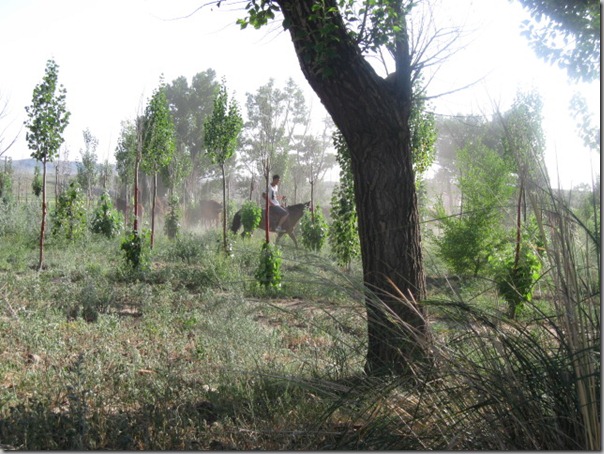
The first leg of the drive was beautiful, in a barren sort of way. D drove along the back roads so we could watch lanky, ochre colored boys drive spindly, wild horses across the plains.
The parched ground was cracked, and nearly smoking in the noon sun. D. drove slowly, stopping every time I pointed my camera out the window. With the day at its hottest, we pulled the cab into an uneven gravel lot overlooking a wide swath of grassland. We ducked under the blistering arm of a wrought iron gate and hiked up the asphalt path until it ended. The plane was endless, and the rocky outcrops broke the smooth face irregularly, providing slivers of inadequate shade, jutting incongruously and impotently out of the landscape. Below us, blinding in the direct light of the summer sun, stretched the reservoir, the surface glassy and brilliant, crystalline and inviting.

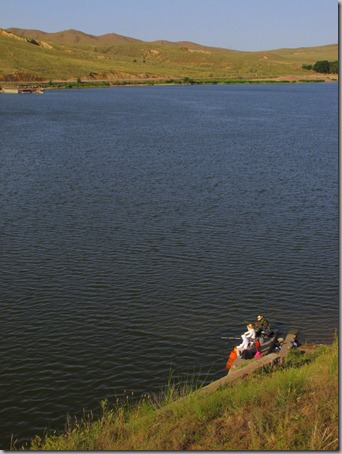
D. led us down a rocky path to the edge of the water, until the stones gave way to a thick, silky mud that coated our feet and left silicate grit between our toes. The water was extraordinary - cool and still, with silvery fish appearing and disappearing rapidly around our ankles. D. waded in up to his waist, and grinned at us. "I never learned to swim," he explained sheepishly. "This is the only water around."

Climbing back onto the rocky shore, we were greeted by a horde of obnoxious teenagers with cell phone cameras taking our picture. "Lao Wai!" They informed each other, pointing. "Lao Wai!" We affirmed. It was like first contact without the spaceship. I encourage you to go to China with a horde of other white people, and simply repeat everything that people say while they take your picture. If you really want to have some fun,
"dai4 wo3 qu4 kan4 ni3de ling2dao3"
means "Take me to your leader," and I suggest that you throw that in once or twice, just to up the ante a little. Trust me. It will be hilarious.
Tourism in China is essentially a carnival of shit that is ridiculously old, where you are hustled from one busted thing to the next and people attempt to sell you absurdly overpriced shirts that depict the busted thing you just saw. For years, tourists have gone to China and paid money to look at old busted shit, which is why, when you go to China, people are really enthusiastic about charging you money to see shit that is old and busted. China is really capitalizing on the two pronged theory that 1) things that are "Ancient and Beautiful" are attractive to populations who continually recycle styles from 20 years ago like there is ANY amount of time that might make stirrup pants acceptable again, and 2) that those same populations with the fashion memories of goldfish are by extension unable to distinguish between a pile of rubble from a defunct noodle stand and some palatial ruins from the Ming dynasty. And who can blame them. We are the assholes acting like jeggings are reasonable. Just be thankful that the T-shirt you bought says you saw the great wall, even if it was "Ping’s discount hovel of pajamas." You know in your heart that it doesn't matter to you.
 a tribute to a nobler age.
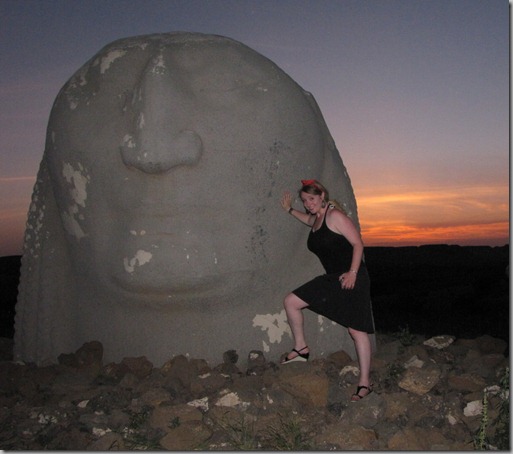
 Acting on the principle that the central tenet of Chinese tourism is "have built it several thousand years ago and they will come," China designs much of their new construction to look like old construction. Our guide led us back to the car, now nearly molten in the heat of the late afternoon, and suggested that he drive us a little out of our way to see the main attraction in the area: a fifteen foot tall replica of Genghis khan's head, molded in plastic and finished to look like ancient stone work; set imposingly on a hill above the largest highway in Xilinhot.
We hesitated. We were in the middle of nowhere, with little money, in sandals and swimsuits, with no other viable mode of transport, no one to call, and no reasonable alternatives. We looked at each other. We shrugged. We agreed reluctantly, and got in the car. We pulled out of the gravel lot, and rejoined the long dark highway snaking across the grasslands. five or ten minutes passed before we again pulled off the highway. D. shut off the engine. "Just a moment," he said to us.
If you are now, like we were then, reading this post waiting for the moment that our seemingly philanthropic guide dropped his mask and stood revealed to us in his true colors, you need to read no further. It was at this juncture that this man's character was exposed in all of its nakedness, burning like a brand in the vast expanse of the dry plains. He left the driver's seat, and moved around to the truck of the car. As soon as he was out of the car, I turned to Fred. "What is going on?!" I asked. We had no idea. Was this the moment he would demand additional payment for his unsolicited tour? Were we going to have to battle it out along the side of a desolate highway in the middle of god knows where in inappropriate walking shoes and damp clothing? Did he realize how threatening the eternal, unbroken plains appeared in the context of our potential disagreement? Would he abandon us? Rob us? Sell us? Would the bland, calcified fields surrounding us soon house the drying HUSKS OF OUR DESICCATED CORPSES? WOULD I BE MUMMIFIED IN FRIGGING MONGOLIA OVER A FIFTEEN DOLLAR TRIP TO VIEW AN ENORMOUS PLASTIC REPRODUCTION OF GHENGIS KHAN'S FAKE HEAD?
We waited anxiously, listening to the thumps and rustles coming from behind us as D. rummaged through the trunk of the cab. For shovels? Shackles? Firearms?
Worse?
The sun was getting lower as D. opened the door and clambered back into the driver's seat, clutching a large sack. His ruddy face was filmed with sweat, and creased into a habitual congenial grin. Under the circumstances, his good natured smile seemed sinister, lochetic, foreboding. Nodding briefly and apologetically to me, he turned to Fred and spoke rapidly in Chinese.
Beaming, he produced two large water bottles from the bag, slick with glistening condensation, kept cold in a cooler in the trunk. Fred translated. "He thought we might be hungry, and he saw on a television special once that white people like to eat bread, so he went to the store. He wasn't sure what kind of bread white people like, though, so he bought us a couple kinds. He said they were out of coca cola, and they only had pepsi, so he got us water. He hopes that's ok. He knows Americans really like coca cola."
Although in a sense anti-climactic, the soft yellow loaf filled with dates and jam was delicious, the water welcome to throats as parched as the steppe. Our guide drove faster through the growing twilight, explaining that if we could mount the next hill quickly, we could watch the sun set over the bright silver rivers leading into the reservoir.
At the summit, we pulled the cab off into the bushes and turned to watch the deepening crimson rays glance brilliantly from the surface of the winding tributaries, and transform the dales into pools of gold and shadow. In the last dying light, a collapsing cottage caught the final beams and blazed into an unexpected beauty, radiant in its liquefaction, in the syrupy golden of the thickening dusk. Never had some old busted shit seemed so compelling in its desuetude; the steppe looked so homogenous in the broad day, but the growing penumbra highlighted the hills and dips. The light on the uneven plain fell in viscous chunks, collecting in dales and running slowly down the hillsides.


Then we turned our steps towards the head of Genghis Khan.

As it turns out, the head is better positioned to view from a distance than it is placed for tenable approach. In our plastic sandals, we climbed over barbed wire fences and the ruins of old cattle pens. Nettles brushed our legs, huge crickets exploded from the brush up into our faces, whirring and clicking like mechanized irritants. Outlined in the dusk, the silhouette was a prepossessing figure from the road. Up close, it was clear even in the advancing night that the paint was flaking, the plastic scraped and worn.
Bushwhacking our way back to the car in the dark, our guide remarked, “maybe we weren’t supposed to climb these fences.”
The freeway was dark, indistinguishable from the rest of our surroundings. No lamps lit the roadway, and there were few cars or trucks shining their headlamps through the summer night. We drove through the night in silence, occasionally irradiated by the headlamps of oncoming cars. Our guide’s face was thoughtful. The steppe was crossed with shadows in the moonlight.
When he broke the silence, his voice was hesitant, and quiet. Music was an important part of Mongolian culture and communication, he told us. Since we had asked so many questions about inner Mongolia, and about the people, he wondered if we would like to hear some traditional Mongolian songs?
We would.
His voice was surprisingly beautiful, pitched high and clear, with a deep expression and wide range. In the deepening night, with the dim luminance of the moon and the dashboard lights, the sound was mesmeric, soothing, compelling.
In the silence after the song, I felt the rising melancholy of homesickness, coupled with the strange sensation of being precisely where I belonged.
As we re-entered the city, D. received a phone call from his wife. He spoke with her for a few minutes, and then asked us if we had enough time to see some famous temples in the city. His wife had admonished him. “Who wants to see a hole filled with water? You should have taken them to the monastery!” As you may have divined, the temples had all been destroyed during the cultural revolution, but had been rebuilt to the exact specifications of a new thing that looks just as busted as it would look were it actually to have decayed over millennia.

His entire family was waiting there to welcome us.

D. looked anxiously over his glasses at us. His son, who had inherited the squat frame of his father, was uninterested in school. His grades were not good, and he insisted he wanted to be a famous basketball player. Maybe we could talk to him? If he were to meet some foreigners, perhaps he would become more interested in learning English?
His wife escorted us all over the temple. The night was clear and warm, and the public square was crowded with people. We posed for several pictures with the family, and talked with the son, and coaxed the daughter, who was terrified of us.

As it grew later, the family drove us home in the cab. They refused to accept any payment beyond the fifteen dollars we had paid earlier in the day, which would barely cover our host’s rent to the cab company, let alone the gas. “Maybe someday,” D. said wistfully, “If I can ever visit America, someone will show me their city, too.”
I thought,
Good luck, pal.
It beggars belief that out there in the world there are more than a scant handful of people who would, with a family to feed, abdicate an entire afternoon of income to spend eight hours showing two strangers the sentimental landmarks of their dreamy childhood; who would turn a stale, contrived burlesque of a temple into a warm, joyful family outing; who would volunteer the depth and breadth of their memories, experiences and tradition in the service of promoting education and understanding; who would modify their curiosity with a superhuman exertion of tact; who would, in light of a broken radio, sing the haunting lullabies of their babyhood in the weak light of an aging cab, a single speeding pool of light on a long, dark, unbroken road.
And please recall that he was out of pocket for several kinds of bread.
So if you ever come across this gentleman, out there in the world, marshal whatever forces you have at your disposal to conquer any baseness or selfishness or impatience in your nature. Set aside your daily concerns, defer some pressing obligations, and spend one afternoon treating a stranger to a personal guided tour of a place you grew up loving. Do it for me. Do it for Karma. Do it in the spirit of building international relations. Or just do it because nothing can approach the experience of encountering, in a howling wilderness, the lesson that ordinary people can have the extraordinary effect of becoming the kindest person you have ever met.


